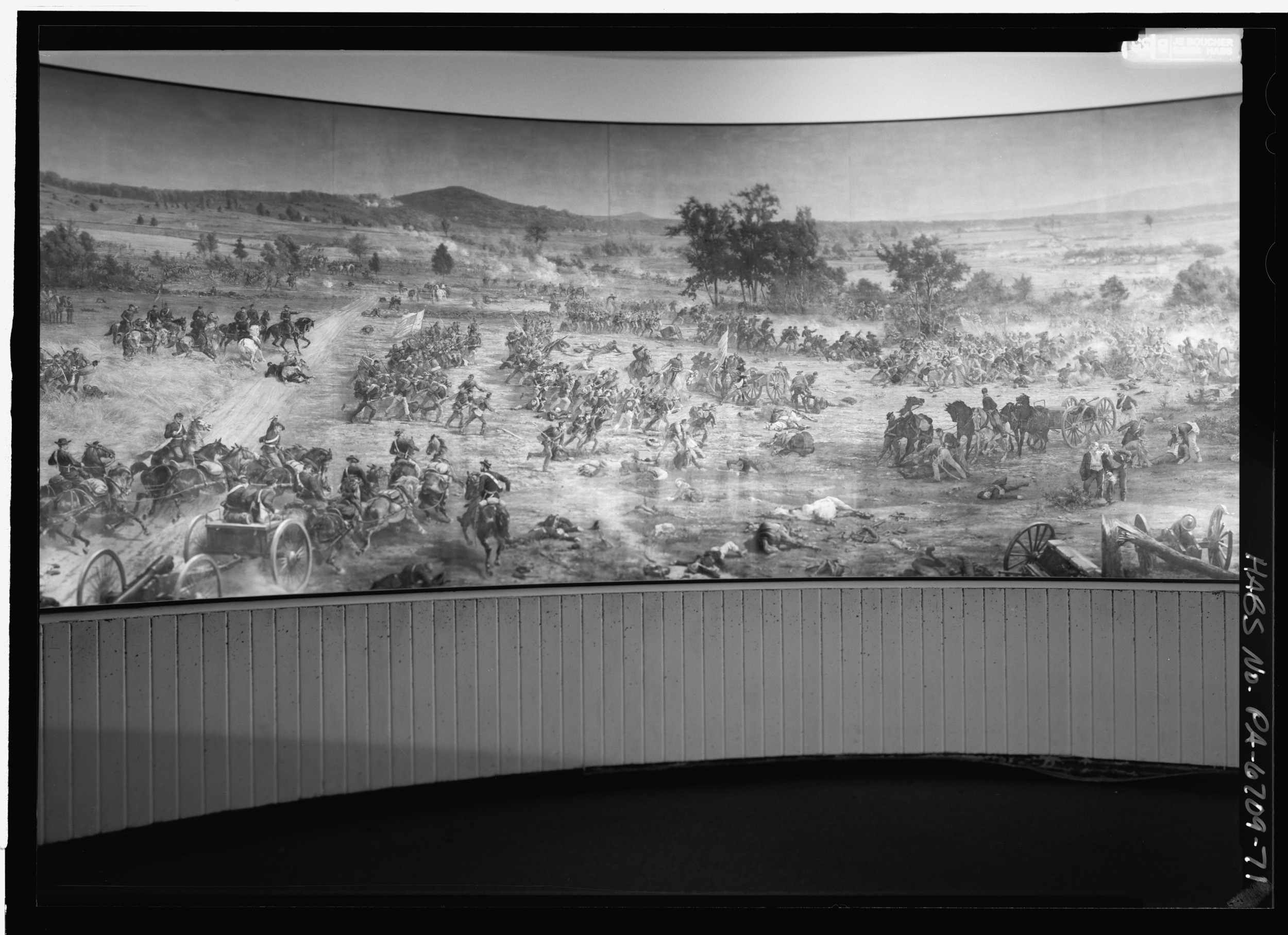
Designed in 1958 and completed in 1962, the Cyclorama Building by Richard Neutra was commissioned to house the Gettysburg Cyclorama, an immense 377-foot panoramic painting by Paul Philippoteaux, completed in 1883, which depicts the climactic moment of Pickett’s Charge during the Battle of Gettysburg.
Though the Cyclorama Building was controversially demolished in 2013, what remains is a legacy of bold architectural experimentation—an ambitious attempt to create not just a museum, but a spatial encounter with time, myth, memory, and landscape. The cyclorama painting itself was a 19th-century form of immersive media. Spanning nearly 14,000 square feet, its scale was designed to engulf the viewer. Presented in the round, with a diorama in the foreground to bridge the illusion, the painting dissolved the frame entirely—placing viewers in the visceral center of the battlefield, surrounded on all sides by smoke, cavalry, and cannon fire.
This posed a unique challenge to Neutra: how to design a building that was not simply a container, but a spatial prologue to an emotional, circular narrative. The architecture could not upstage the painting, nor could it merely encase it. Neutra had to conceive of a structure that subtly primed visitors for disorientation, awe, and reflection—while remaining invisible in its theatricality. The commission came under the aegis of the National Park Service’s Mission 66, a nationwide initiative to modernize infrastructure at U.S. national parks by the centennial of the service in 1966. While most Mission 66 architecture was utilitarian, the Cyclorama Building was elevated—entrusted to Neutra, whose modernist vocabulary might seem, at first glance, an unlikely fit for Civil War memory. But Neutra was not a stylist. He was a systems thinker, and it was precisely this sensitivity—to human movement, landscape, light, and perception—that made him the right author for such a charged site. Gettysburg was not a blank canvas. It was a palimpsest of collective memory, a terrain etched with the stories and tensions that continue to shape American identity.
The chosen location—along Taneytown Road, just north of Cemetery Ridge—was rich with symbolism. From this rise, one could gaze across open fields where Union lines held against the final Confederate assault. Neutra responded by orienting the building not as a monument, but as a kind of optical instrument, a device for viewing both art and battlefield in slow, successive layers. Neutra’s design was unequivocally modern but profoundly responsive. The Cyclorama Building was circular in plan, echoing both the format of the painting and the cyclical motion required to view it. The circularity was conceptual, not just formal: visitors ascended a gently spiraling ramp through a series of light-filtered chambers before reaching the central rotunda, where the painting unfurled in a 360-degree immersion.
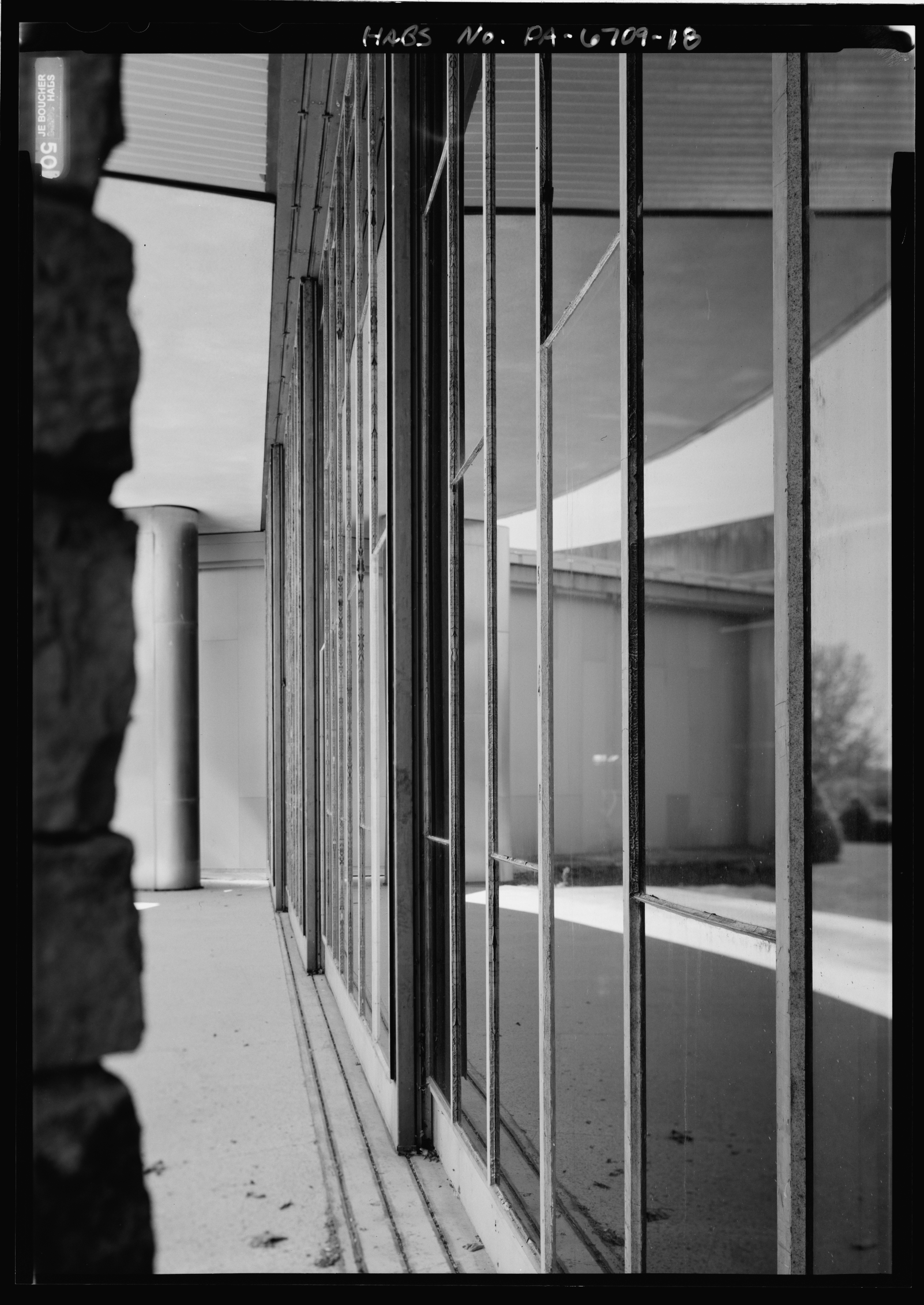
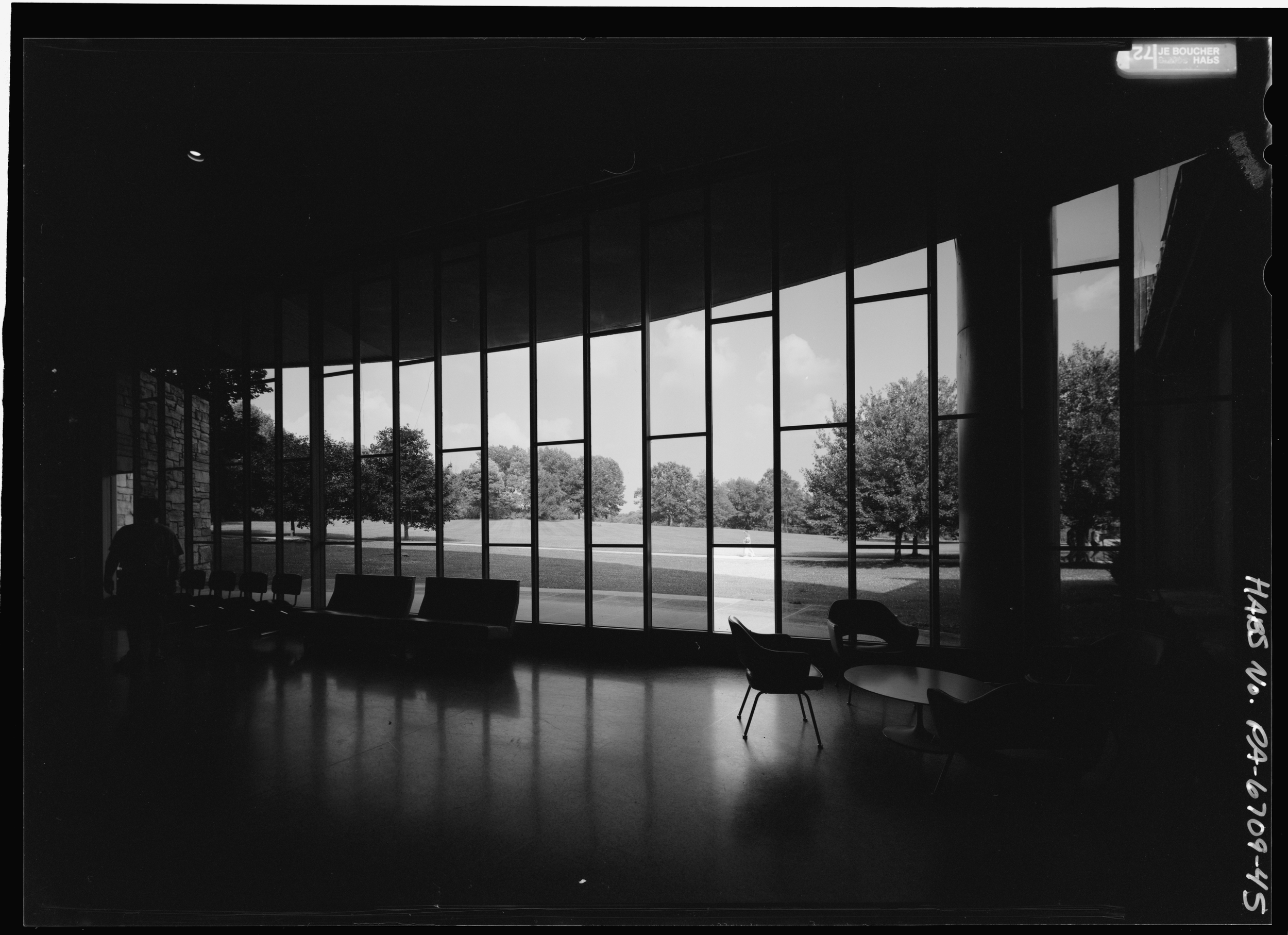
The spiral ramp was more than circulation; it was choreography. It structured time. Visitors moved upward like smoke or memory, gently distanced from the ordinary world before being engulfed in the illusion of 1863. The exterior, clad in textured concrete panels and supported on slender pilotis, was low, hovering, and restrained—almost recessive within the open landscape. Horizontal bands of glazing near the roofline brought in diffuse light, while carefully placed windows along the ramp offered compressed views of the battlefield, acting like cinematic stills: here a clump of trees, there a rolling hill—the real site stitched together with painted illusion inside.
Light in Neutra’s Cyclorama was a critical, sculptural element. He designed a clerestory ring around the drum of the painting to admit natural daylight in a controlled, indirect manner. Unlike museums that conceal or block light to protect artifacts, Neutra used filtered daylight to animate the interior, echoing the changing conditions of the landscape beyond. The material palette was modern but muted: precast concrete, glass, aluminum mullions, and polished stone floors—each selected not for ornament, but for their capacity to recede and defer attention to the painting. The building had a thermal clarity: cool surfaces, rhythmic shadows, the absence of historical reference. Yet it was not austere. It was reverent in its restraint.
Technologically, the building represented a significant feat. The massive rotunda had to support and shelter the enormous cyclorama canvas without direct contact. Neutra worked with engineers to devise a suspended circular structure, where the painting was mounted internally like a continuous curtain, with catwalks and lighting rigs subtly integrated into the architecture. Perhaps most importantly, Neutra’s design was in dialogue with the Gettysburg landscape. This was not a building dropped onto a site—it was draped within it, following the rise of the land and avoiding disruption of sightlines across the historic field. Neutra conducted extensive studies of the topography, sun angles, and native vegetation to ensure that the building sat low and contemplative, rather than monumental. His relationship with the National Park Service was not always easy. Many officials favored traditionalist or neocolonial styles for commemorative buildings. Neutra argued for a non-literal approach to history, one that used abstraction to provoke deeper reflection. His modernism was not an aesthetic rebellion—it was a moral stance, aimed at creating spaces of clarity, neutrality, and openness.
The most striking aspect of the Cyclorama Building was not its structure, but its dual authorship: a 19th-century painting and a 20th-century architecture working together to create a total artwork. It was a rare and delicate fusion of visual narrative and spatial experience. The painting offered a horizontal immersion in time and battle; the building offered vertical ascent, distancing, and return. The former pulled visitors into the fire; the latter cooled them in reflection. In this way, Neutra created a poetic counterpoint: architecture as epilogue, as memory palace. By spiraling through light and silence toward the roar of battle, then emerging again into the calm of the Gettysburg fields, visitors underwent a ritual. The experience was neither nostalgic nor clinical. It was meditative, physiological, and human. Despite its brilliance, the Cyclorama Building became the subject of decades-long controversy. Preservationists, architectural historians, and modernist advocates fought to save it; Civil War traditionalists and battlefield purists fought to remove it. In 2013, the building was demolished—officially to “restore” the battlefield to its 1863 appearance. Yet this logic betrayed a misunderstanding: Neutra’s building never desecrated the field. It extended its meaning into modern consciousness. Today, only fragments of its memory remain: architectural drawings, a few salvaged panels, and grainy photographs of visitors. Yet its legacy endures as one of the 20th century’s rare examples of architecture designed to house a painting—and to become one in its own right. The Gettysburg Cyclorama Building was not just a shelter. It was an instrument for seeing, for remembering, for lingering in the uncertain space between art and land, image and light.