
Rosa Barba is an artist and filmmaker whose work explores the material, political, and poetic dimensions of moving images, sound, and light. Often working with film projectors, sculptural installations, and architectural space, Barba treats light not only as a means of illumination but as a physical and temporal substance. Across her practice, light functions as both medium and subject—shaping perception, activating space, and inviting viewers to reflect on the conditions through which images are produced and experienced.
THE LIGHT OBSERVER : You approached photography at a very early age, then moved to super 8 and filmmaking. What drew you to photography and film? How has your understanding of light evolved over time?
ROSA BARBA : I started early to photograph and develop the images myself. In the darkroom I experimented with exposures and other lighting techniques. When I turned to video using a movie camera, it was always very important to me to expand the spacial possibilities but also continue experimentation with time and light. These methodologies evolved more to conceptual understandings of light over time.
Since 2010 you are working on a series called White Museum, using a film projector to throw a squared field of white light to the surrounding landscape. What is so appealing about light as a medium?
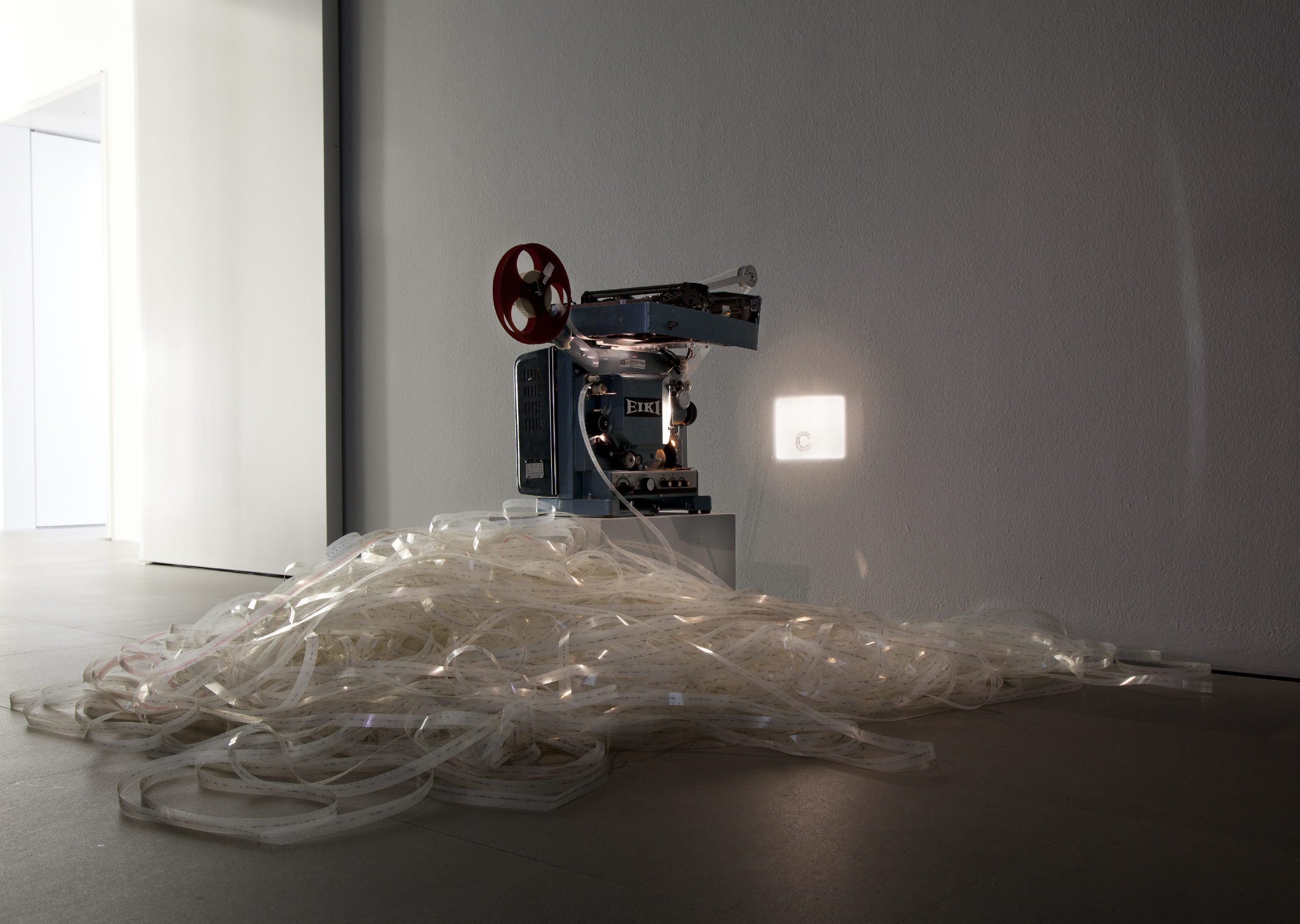
In my installations, I explore film and its capacity to simultaneously be an immaterial medium that carries information, and a physical material with sculptural properties. The category of film is expanded and abstracted beyond the literal components of the celluloid strip, the projector through which it passes and the image projected onto a screen or beyond—where the landscape itself forms the screen. Each component becomes a starting point for artworks that expand on the idea of film while exploring its intrinsic attributes. In White Museum the concept of physical and dimensional space is collapsed with the mental and conceptual space. The Spatial experience is bringing that into the frame as the whole senses are activated. It’s all condensed into each other: sonic and visual. The Transmitter and Receiver are fluent. I started the White Museum in 2010, when I was invited for this exhibition at the Centre d'art at de I'lle de Vassiviere in France, which is located on this artificial island built in the '50s through a water dam. I visited this art centre that had this massive architecture, this long building with this little tiny window at the end facing the lake where the whole city was submerged, that whole village, in order to make this water dam. I saw it and suddenly found this possibility that the museum would become almost an engine or a machine that is producing, something like a machine. Anyway, I was already, at this point, very much interested in how architecture can actually be itself the passage and this is creating something that has actually been visible outside of this museum, the outside also merging with the history of that side. This possibility that you could throw a light onto it might not be otherwise something you would immediately see or understand.
You like exploring cinematographic language by dissecting it, in a way. The idea of fragments seems to play a great role in your work. You've been projecting text fragments onto the wall in Spacelength Thought (2012) for instance. Do you consider each of your projects as fragments of the body of work you're creating as an artist?
We can provide only fragments to perceptions and hopefully these fragments are useful to understand certain perspectives of our world and how we can build up on them.
In Spacelength Thought, a Typewriter continuously prints text onto a 16mm white film, and thus prints its own code, or decoded story. It’s an author, but the text production does not adapt to a human reading routine; it extends the production time of a single word or even a single letter in this case, but at the same time moves at the pace of the celluloid. The piece is a manic writer, driven by a powerful production energy, endlessly inscribing text into film.
Speaking of fragments, I'd like to quote some words from Jonas Mekas, an important figure of avant-garde cinema. "Most of my videos consist of fragments, one or two minutes long. They are haikus or sketches. I have thousands." Somehow, do you see your art installations as short poems?
Yes, I can very much relate to that. But not all works are short poems, often they are zoomed in ideas or even instruments that can evoke a space beyond.
You've been carrying out several Land Art projects. What has been special in the making of Solar Flux Recordings in 2017? Can you describe the installation and the idea behind it?
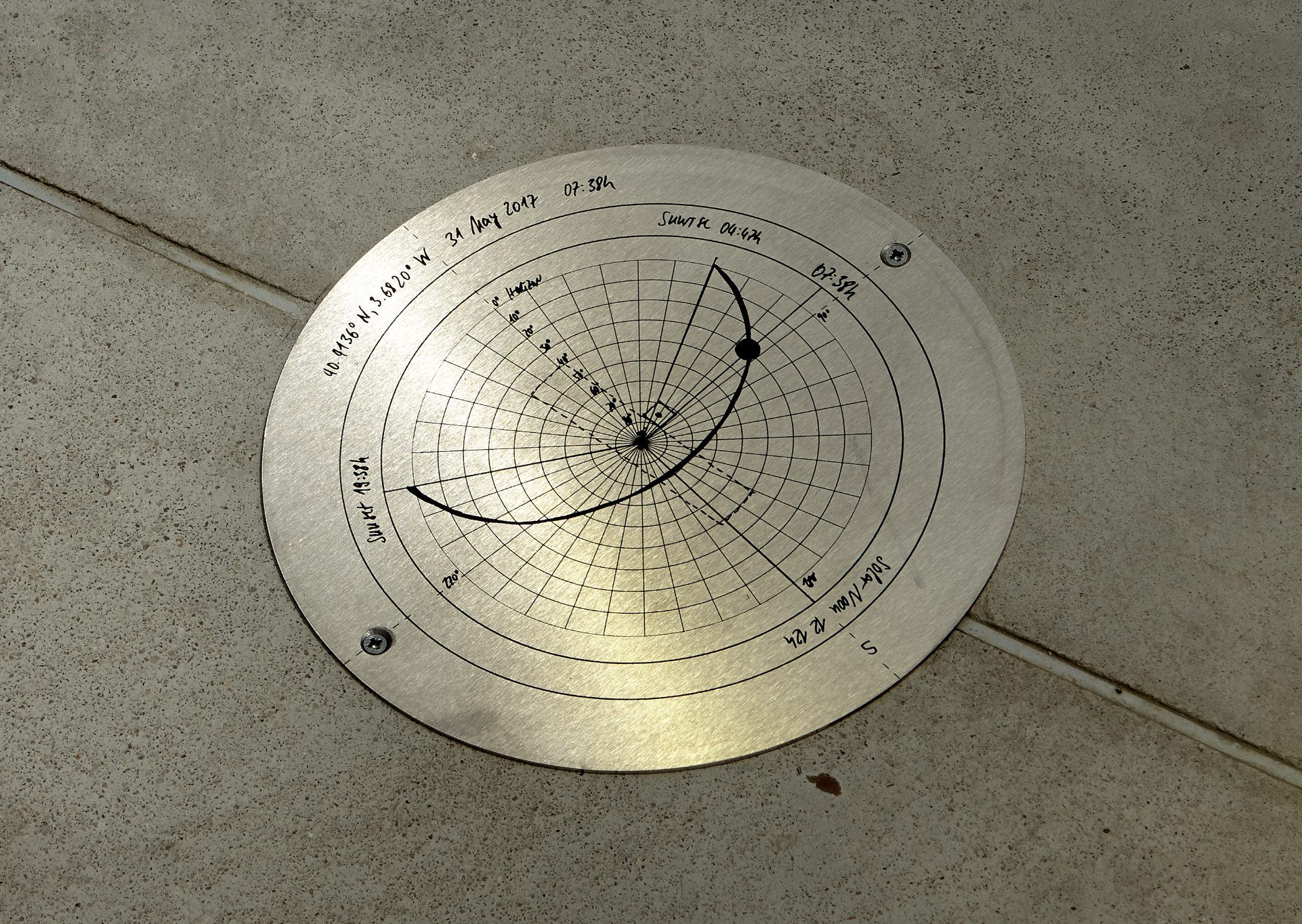
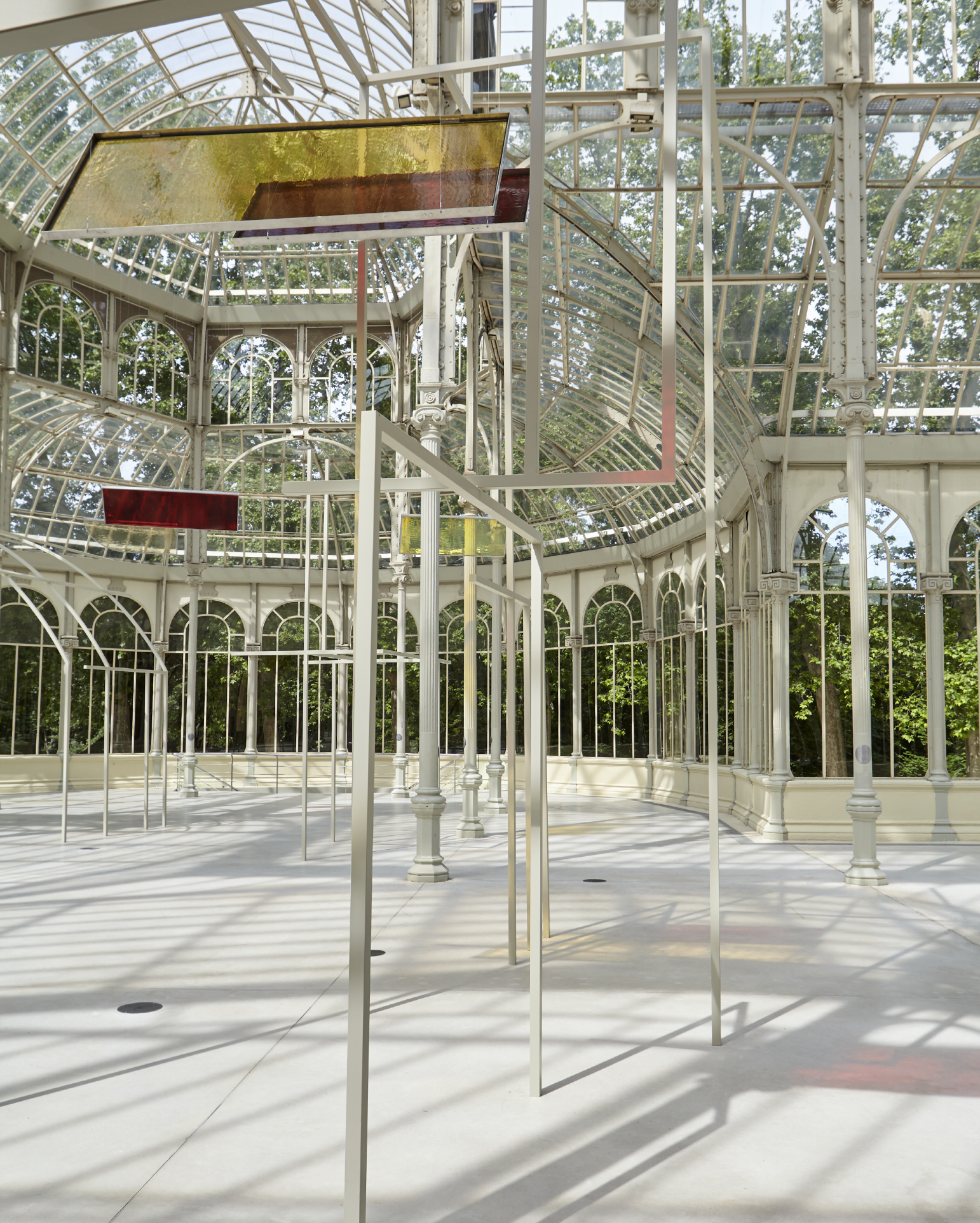
Not sure if we can call Solar Flux Recordings a Land Art Project. It was a special invitation by the Reina Sofia to work with the Palacio Cristal which is extremely filled with light, constantly and has a powerful architecture which makes it impossible to compete with art works. I decided to use the whole building as a kind of machine and turned the activity of it into a piece. I calculated how the sun would travel over the building over the 3,5 months of the exhibition period and marked 9 “recordings” of the sun. These were manifested on some metal plates and mounted on the floor. I fragmented the vocabulary of the building and turned it into 9 sculptural forms which were abstractions from the exact material. These were placed inside with hanging hand-blown glass plates above them. These glass plates were angled to the exact position the sun would hit them at the 9 specific recordings. The sun was passing though those glass plates and throwing the coloured projections with the movement of the sun inside the building and also outside of the building. The sun was basically painting the building and floor and even sometimes hitting outside of the park.
The architect Ricardo Velázquez Bosco made the structure out of glass set in an iron framework so the building benefits from natural daylight. Sunlight is the protagonist of the installation. Can you explain to the people who haven't seen it what the result was like?
The result was a performance by the sun with some seconds of fixed recordings, when the sun was precisely hitting the metal plates. These plates were also indicating the date and hour of this happening every 2 weeks from the start of the exhibition till the end. As the building’ original purpose was to showcase the glory of tropical plant life from the Philippines which at the time was a Spanish colony. Now it was turned into a sun clock and the complete result was not palpable—only glimpses through its activity.
I know you’re quite busy these days, can you tell us about your upcoming projects?
I just did an exhibition at the CCA Kitakyushu in Japan with several films and installations and I am now on my way to the Setouchi Islands to install two more works there. This fall I will present a new performance at the Armory Park Avenue with Chad Taylor. We also will perform in Marfa, Texas at the Chinati Foundation as part of Desert Encrypts. I will premiere a Theater collaboration at the Wilma in Philadelphia, a mise-en-scene of a poem entitled “There” by Etel Adnan.

The first issue of The Light Observer focuses on exploring light in different forms and areas. For this issue, Nathalie Du Pasquier created a series around the theme of light: a storytelling mixing words and drawings entitled LUX. The fine pattern, humour, acute sense of shape and colour make this collection very distinctive and recognizable. We also met the great explorer and scientist Michel Siffre and spoke about his adventurous life and discoveries. The director of photography Marco Graziaplena will tell us about his experience on set with Abdellatif Kechiche and his approach to filming. Montreal based photographer Guillaume Simoneau speaks about his relationship to light and telling personal stories through photography. And many more exciting stories!